Wednesday, 16 February 2011

A Green Man

I've only just got round to picking up a copy of Jacqueline Simpson's recent book on the folklore of pub names (1). It is the kind of well-researched delight we have come to expect from her, and I'm enjoying it very much.
I'm also extremely chuffed to find myself mentioned in the acknowledgements there. When she was researching the changing iconography of Green Men in pub signs, Jacqueline had asked around for any images people might have. She was thus able to describe a number of signs, including 'The Green Man on the corner of Plashet Grove and Katherine Road (London E6) [that] shows a "wild man" figure carrying a tankard and standing next to a barrel' (p. 121).
Here's the photo on which she based that description. I'd taken it in part because the pub was closing down, and I felt there should be some record of the motif in use there before evidence of it disappeared. The building was subsequently demolished, and a block of flats is nearing completion on the site.
There had been quite a lot of local interest in the pub because it was one of the older buildings in the area. (Although it wasn't a great pub by the time I knew it). I'm pleased that such interest can also be used to inform other research.
* * * * * *
1: Jacqueline Simpson, Green Men and White Swans: The Folklore of British Pub Names (London: Random House, 2010).

Thursday, 10 February 2011

A meme streak

Last night's Newsnight saw Paul Mason appealing to the notion of 'memes' for the circulation of radical ideas. (He'd already floated the idea on his BBC blog). I hadn't intended to get into the question of meme-theory here yet. It's quite a broad field, as I've found in my doctoral research.
I've not been convinced by memes thus far. To a great extent they seem like a judgemental short cut advanced by disapproving scientists to account for religion without viewing it in any broader social context. To quote an abstract by Susan Blackmore, 'Not only does the God meme satisfy minds that were not evolved to accurately assess the origins of the universe or the likelihood of life after death, but wraps itself up in religious memeplexes that use threats and promises to ensure their own propagation'.
There are a number of problems with this. For one, it doesn't really account for contrary theories held by minds presumably at exactly the same evolutionary disadvantage. As some critics have noted, there does not seem to be a tendency for bad memes to be countered by good ones. In the work of Richard Dawkins, for example, there is a tendency for bad memes to be countered by rational criticism, which doesn't seem to have memetic status. (1) Indeed, some scientists have pointed to this problem more generally. Lewis Wolpert has written 'Just what a meme is, and how it is distinguishable from beliefs, I find difficult. Is the word "bird" a meme, and is the second law of thermodynamics also one?' (2)
This tendency of memetics reveals a lack of familiarity with the study of traditional narrative and its transmission. Schrempp has pointed out that folklorists have long dealt with the transmission of traditional narrative elements - 'less ideologically and more scientifically', he notes archly - in trait and motif studies. (3)
A related problem, with more serious implications, is the implication that these motifs are themselves responsible for their own transmission. (This is clearer in Blackmore's writings than in Dawkins's). Folklorists' examination of motifs and types does not proceed from the assumption that the stories are transmitting themselves. What sounds like the ultimate in materialism from the memeticists is a way of removing human agency from cultural artefacts. It gives the idea supremacy in its philosophical framework. If you tell a myth, or believe in a god, this is evidence of your human failings in the face of quasi-genetic elements, rather than any cultural expression.
Distasteful though I may find it intellectually, however, the 'meme' has acquired a certain folk life as a way of representing transmitted ideas. You do find it in popular discussion, and in that respect it must be taken seriously. It exists as a popular and vague definition. (I don't like the popular use of 'folklore' to mean something false, but I recognise it exists, and has to be factored into any appraisal of emic analysis).
What's interesting about Mason's appeal to memes is that you see that process at work. Although he pays lip service to the notion of self-replication, in practice he actually abandons much of the contentious baggage because he sees it in terms of agent-driven communication: 'ideas arise, are very quickly "market tested" and either take off, bubble under, insinuate themselves or if they are deemed no good they disappear. Ideas self-replicate like genes. Prior to the internet this theory ... seemed an over-statement but you can now clearly trace the evolution of memes'.
I still find it a vague and unhelpful concept, in origin profoundly ignorant of any study of traditional communication, but there does seem to be some attempt to use memes now to express something closer to the items that people transmit between themselves. There seems to be some attempt to restore human matter to the transmission of non-material artefacts between people. To restore the folk to the folklore, maybe?
* * * * * * * * * *
1: Gregory Schrempp, 'Taking the Dawkins Challenge, or, The Dark Side of the Meme', Journal of Folklore Research, 46.1 (2009), 91-100.
2: Lewis Wolpert, Six Impossible Things before Breakfast: The Evolutionary Origins of Belief (London: Faber and Faber, 2006), p. 30.
3: Schrempp, 'Dawkins', 98.

Wednesday, 2 February 2011

The legal historian of cannibalism at sea

I'm sorry to hear that the legal historian AW Brian Simpson has died. There's plenty of detail in Christopher McCrudden's obituary in The Guardian.
Simpson's probably best known to folklorists (and most general readers) for Cannibalism and the Common Law, his classic account of the Mignonette tragedy and its ensuing legal case. (This established the precedent in English law that you could not kill someone to eat them, even in the most extreme of circumstances). I've written on the case here before.
It's an excellent book, rich with ballad and customary evidence, and it's invaluable for anyone trying to understand the clash between folk culture and the law. I used it extensively when I was working on Thackeray's poem about cannibalism at sea 'Little Billee' for an article in the Folk Music Journal, 9.5 (2010).
I don't know whether Brian Simpson ever saw this article, but he was certainly uppermost in my mind when I came to illustrate it. He had quoted a broadside ballad about the Mignonette, 'Fearful Sufferings at Sea: Lad Killed and Eaten', but wrote that he had never seen a copy of the ballad. It was serendipity that, while looking for ballad illustrations in the Vaughan Williams Memorial Library, I came across that very ballad in Ralph Vaughan Williams' own collection. It now adorns the cover of that issue of the journal. Its inclusion was always intended as, and remains, a small tribute to Brian Simpson's sterling work.

Monday, 17 January 2011

Ratkings

Fiona-Jane Brown has a complaint about the last of the BBC's Aurelio Zen adaptations (which aired last night). At no point. she says, did anyone mention what the 'Ratking' of the title was. As a rattophilic folklorist, I'm happy to oblige. (F-J knows, by the way, she just thinks other people should too).
The rat king is a phenomenon whereby rats apparently become knotted at the tail while they are in the nest. The famous image here is of an example from Rucphen, but there are one or two other good examples in museums around the world. The Rucphen one has been x-rayed and, yes, the rats, really are knotted together at the tails. (It's been suggested that the tails were broken and had re-knitted, which might cast a doubt on the idea that this occurred naturally when they were young).
So, there's a question-mark over whether this really is naturally occurring or whether it's been 'arranged' at some point. Apart from the actual object, what's interesting from it folklorically is that it's attached to reports of intelligent social behaviour from the rats. The rat king supposedly occurs in the nest while the rats are young, which would be a problem for their future development. Rats, though, have a reputation for cleverness, and for looking out for each other, so other rats are supposed to bring food back to the nest for the afflicted animals.
This ties in with all sorts of other folklore about rats' social behaviour. There are contemporary legends reported from Germany of two rats, each holding the end of a straw in their mouths as they scuttle round a farmyard. On closer inspection the trailing rat is found to be blind, and is being led around by its colleague. As rats swarm, there are also tales of a dominant rat leading them in their flight, and their flight is also taken as prescient of impending danger. (There's a story about rats swarming down main roads away from the bombing during the Coventry Blitz).
Just before Christmas I had the chance to see some of Walter Potter's taxidermy tableaux. The theme of the intelligent rat recurs throughout his work, although it's perhaps less well known than his kittens. In 'The Friend in Need' (below) a rat is caught in a trap. There is a concerted and intelligent effort to free him by his friends. Potter seems to have broken the faces of his rats to make them seem less visually ratlike, but it's clear that he's still dealing with folkloric ideas about rats.
In another tableau Potter portrayed rats stealing eggs. As P.A. Morris puts it, 'This is an evergreen topic of folklore in the countryside, even today. Potter admitted that he never saw such a thing himself, but created the case based upon what a clergyman (presumed to be a reliable witness) had told him'.(1) Right there you have the folkloric idea, and its transmission.
There was also a tableau of rats attempting to steal wine. This was based on another story resting on similar ideas about their intelligence. Rats are reputed to dip their tails into wine or oil, and then lick the fluid off it. (This image, and the egg-stealing, can be found in reproduction in this article about Potter).
That was a new one on me, but it fits perfectly with the other folklore about them. I really never will stop finding them fascinating.

* * * * * * * * *

1: P.A. Morris, Walter Potter and His Museum of Curious Taxidermy (Ascot: MPM, 2008), p. 63.

Wednesday, 12 January 2011

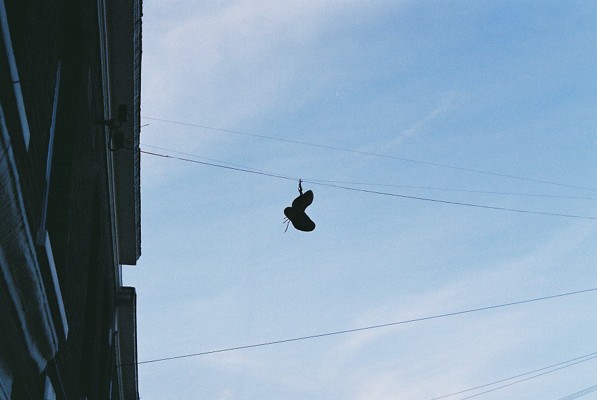
Shoes on telephone lines


The new year finds me beavering away, wrestling full-time with finishing the thesis. So, to remind myself of some other folkloric things I love, here are some shoes thrown over telephone lines. There are all sorts of reasons for it as behaviour. I don't know why these are here, and I don't claim to have any handle on all of the reasons why they might be. That's part of the attraction of studying folklore. These were photographed in Goodwood Road, London SE14, on 16th March 2010.

Thursday, 23 December 2010

Season's Greetings and a Horse Disguise

I'm now deep in the throes of writing my thesis, and unable to get away from ghosts no matter how hard I try. I even received a Christmas card this morning illustrating the M.R. James story 'Oh Whistle and I'll Come to You, My Lad'. The card's manufacturer insists that 'Ghost stories are a tradition at Christmas'. This is true enough, and there's plenty of scope for research into traditions of telling literary ghost stories for seasonal entertainment, but I've put any other research projects on hold until I'm done with this thesis.
I'm looking forward to an end to this odd year, and looking forward to the promise of a new one. I can't think of a better way of marking the season than with a photo of a splendid winter house-visiting custom from East Kent, the Hooden Horse. This picture is of the St Nicholas at Wade horse. I had a rare chance to photograph them out of season (and away from their home turf) on 29 March 2008 when they performed at the Kent Gathering of Traditional Music in Frittenden. (Along with their history, Ben Jones's fine website on hoodening also has details of the script they used that day). It was a treat, and the thought of it cheers me up for the new year.
All the best for Christmas and the New Year

Friday, 5 November 2010

Remember, remember ...

Sitting at my desk I'm becoming aware of a rise in noise levels now it's got dark and the rain's eased up. A combination of Bonfire Night and Diwali means it may be about to get too noisy to carry on working.
A Leeds informant, in his early 40s, was telling me recently about their favourite Bonfire Night prank as children. They would steal the front-gates from local houses to use on their bonfires.
The theft provided an additional source of entertainment. A local man navigated his way back from the pub by working his way along the front hedges, singing all the while. There would be a sudden lull in his singing when he came to a gate that wasn't there to support him any more, and he would fall unceremoniously into a neighbour's garden.

Saturday, 30 October 2010

Halloween: Trick or Contemporary Legend

Halloween in the UK this year has seen a higher degree of debate about the history and transmission of the festival than I can recall from previous years. In particular there's been an attempt to trace its transatlantic migrations more accurately than the knee-jerk 'it's an American festival' of some of the tabloids.
I'm also struck by the extent to which some older local formulations seem to be reappearing in discussions of the chaos around Halloween. In a report on home repairs after Halloween pranks, Santander General Insurance refer to the damage done during 'mischief week'. (They reckon nearly a quarter of British households have experienced damage, which may be why my local council is enforcing a ban on selling flour and eggs to under-18s for the duration).
But, of course, the real meaning of Halloween is the Contemporary Legend ... I'm delighted to see a return of the 'doctored Halloween treat' story, with this report that LA County Police are warning parents of an increasing number of marijuana-laced treats. (This is a difficult legend, because of the hideous ostension attached to it historically).
In the story linked to here, I particularly like the vagueness about the products themselves. LA County Director Public Health Jonathan Fielding has apparently said they are a risk 'because of the lack of information regarding their manufacture', while the story recommends detecting them 'by smell'.
The real pointer to the legendary character of this report, though, comes in this succinct statement: 'Although the Sheriff's Department has never received a report of laced Halloween treats being distributed, it is nevertheless warning parents about this new potential threat.' You have been warned.

Tuesday, 19 October 2010

Folklore in the news means cold on the way

The early arrival of eight Bewick's Swans (Cygnus columbianus) in Gloucestershire has, surprisingly, made the national press. The reports aren't about how attractive these small swans are. Rather, they focus on the distances they travel. 'Prone to ceaseless wanderlust', in the words of one ornithologist, Bewick's Swans fly some 2,500 miles from Russia/Siberia to overwinter in Britain.
More particularly, the press are interested in the date of their arrival. These birds have arrived a couple of weeks earlier than last year's migrants, and journalists have started reaching for Folklore. This, fairly standard version, was in the Telegraph: 'According to folklore, their early arrival signals the start of a long, harsh winter'. This makes a sort of sense, as Bewick's Swans fly south-ish to get away from Arctic winters, and early movement might indicate an early worsening of the weather behind them.
Looking at Richard Inwards's 1893 collection Weather Lore: A Collection of Proverbs, Sayings & Rules Concerning the Weather (repr. London: Senate, 1994), turns up a definite association of swans with bad weather. Inwards notes a Scottish belief that 'When the white swan visits the Orkneys, expect a continued severe winter' (p. 134). More generally, their flight is associated with rain or hurricanes. The rain connection seems quite venerable: Inwards quotes Dryden's translation of Vergil:
The swans that sail along the silvery flood,
And dive with stretching necks to search their food,
Then lave their backs with sprinkling dews in vain,
And stem the stream to meet the promised rain

They're a lovely sight, but it might be time to wrap up warm.

Thursday, 7 October 2010

Gilda O'Neill

I'm shocked to learn of the sudden death of Gilda O'Neill at the age of just 59. I first came across her work because of an interest in hop-picking. Her oral history of East London women hop-pickers, Pull No More Bines: Hop-Picking: Memories of a Vanished Way of Life (London: Women's Press, 1990) was a brilliant study. It combined a sympathetic ear with an acute eye. She successfully achieved the balance of writing in an informed and objective way about something she also remembered experiencing. (It's still in print, now published under the much less evocative title Lost Voices).
She tried to bring serious thought about history to an audience that might not have had much opportunity for serious study. Her books were accessibly written, and focused on the East End working class life she had grown up with. They are rich with the minutiae of folklore and history. Her book about women's socialising A Night Out with the Girls (London: Women's Press, 1993) seems less well known than her big histories, but I remember being struck by its sheer pleasure at the social events it was examining, and the thoughtful points it made about them along the way. I haven't read any of her novels, but everything I've heard about them suggests she brought the same determined combination of accuracy and accessibility to that genre too.
Having benefited from a return to education as a mature student, she worked hard to inspire people from the same background as her to consider its possibilities. The photo shows her (right) talking with Maggie Semple at a National Reading Week event in 2008. Given this government's likely curtailment of adult education opportunities, her enthusiastic contribution on this front deserves mention.
Her accounts of working class life in the East End sought to celebrate the lives of ordinary people, and to use their history as a prism through which to view current events. She leaves a valuable body of work that remains a pleasure to explore.